MultiversX Unveils Native L1 Integration With OpenAI and Stripe's Agent Commerce Protocol
MultiversX Unveils Native L1 Integration With OpenAI and Stripe's Agent Commerce Protocol
MultiversX just shipped another infrastructure layer for AI-driven transactions.
AI agents can now discover products, execute purchases, and settle payments onchain without leaving the chat interface. No wallet friction. No gas dependencies. Direct blockchain execution.
What ACP Actually Is
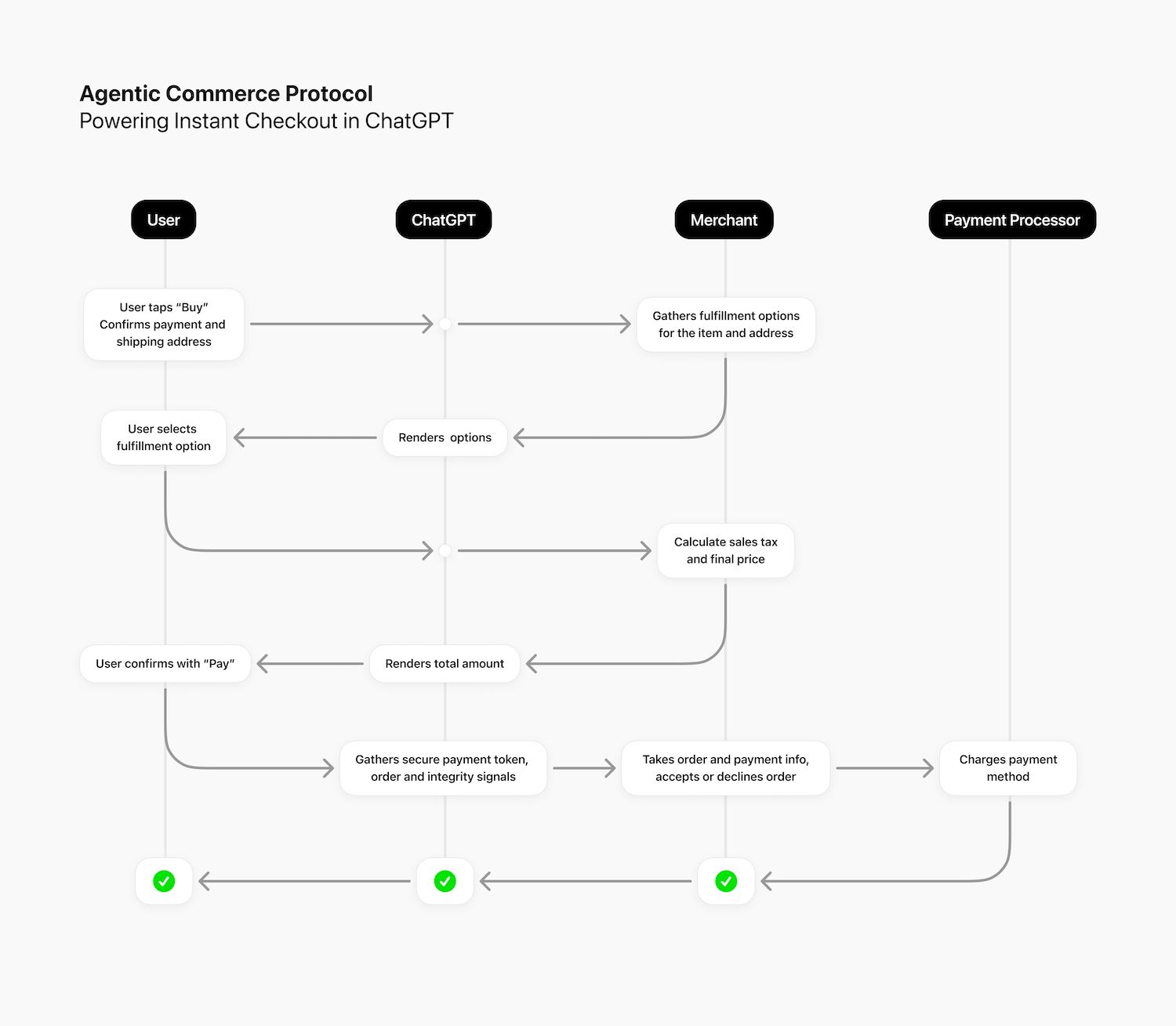
The Agentic Commerce Protocol (ACP) is an open standard developed by OpenAI and Stripe that enables a conversation between buyers, their AI agents, and businesses to complete a purchase.
Think of it as the checkout API for AI.
When you ask ChatGPT to buy something, ACP defines how the agent discovers products, constructs the transaction, and completes the purchase… all within the chat interface. The merchant stays in control. The user authorizes the transaction. The agent handles execution.
MultiversX now supports ACP through an open-source adapter at: github.com/sasurobert/multiversx-acp-adapter.
ACP and UCP: Complementary Standards
Google recently launched the Universal Commerce Protocol (UCP), which takes a broader approach in covering the full shopping journey from discovery through post-purchase support, not just the checkout moment. UCP is currently implemented in Google surfaces like Search AI Mode and Gemini.
Starting today, we are proud to announce that MultiversX supports both protocols.
ACP focuses on the transaction moment itself, standardizing how agents initiate purchases across any platform. UCP extends that to the entire commerce lifecycle within Google's ecosystem. They're not competing standards; they address different parts of the agent commerce stack. Merchants don't need to choose one. Both expand the surface area where autonomous transactions can occur.
What Ships Today
MultiversX's ACP implementation delivers two production-ready capabilities that make agent-driven commerce viable on blockchain.
Programmable Buying Power
The adapter makes MultiversX assets discoverable to any ACP-compatible AI platform: ChatGPT, Claude, Gemini, and open-source agents alike.
Merchants expose standardized product feeds. Agents query those feeds, construct transactions, and execute purchases via standard HTTP requests. Users never leave the chat interface.
This shifts AI from conversational to transactional. Instead of explaining how to buy an NFT, the agent executes the purchase. The adapter handles protocol translation, converting natural language intent into correctly formatted MultiversX transactions with proper nonces, gas estimates, and signature requirements.
Because ACP is blockchain-agnostic, agents don't need network-specific training. An agent that understands ACP on one network can operate on MultiversX immediately. For developers, this means implementing a single specification makes your application instantly discoverable and transactable by agents across multiple platforms.
Gasless Transactions via Relayed v3
MultiversX's implementation includes native support for gasless transactions through Relayed v3.
Traditional blockchain commerce requires users to hold native tokens for gas fees. This creates a circular dependency: agents need tokens to transact, but acquiring tokens requires transacting.
Relayed v3 solves this at the protocol level. Agents construct transactions. Relayers cover gas costs. Users don't need to hold EGLD.
This isn't a third-party service or subsidized workaround but protocol-level functionality that works for any transaction type. The ACP adapter exposes this capability directly through its delegated payment flow.
For autonomous agents executing high-frequency or micro-value transactions, this makes the economics work. API calls paid in fractions of a cent. Conditional automation. Streaming payments. All viable without gas fees overwhelming the underlying value.
What This Unlocks
ACP provides the foundational commerce layer: agents helping users buy from businesses.
But MultiversX's architecture, from standardized interfaces, gasless execution, to the sub-second finality brought by Supernova, enables more sophisticated coordination mechanisms on top of this base.
Agent-to-Agent Work Contracts
With ACP as the commerce interface and Relayed v3 handling gas, the next protocol layer becomes viable: autonomous work contracts between agents.
The pattern is straightforward:
- Agent A needs a specific computation performed—image analysis, data processing, API orchestration.
- Agent A discovers Agent B's capabilities through an ACP-compatible feed, constructs a work agreement specifying deliverables and payment terms, and initiates an escrow transaction. Funds lock onchain.
- Agent B performs the work and submits proof. An oracle validates the deliverable against the agreed specification.
- If verification passes, the escrow releases payment automatically. If it fails, funds return to Agent A.
This unlocks true agent composability. Rather than monolithic AI systems attempting to handle every task, specialized agents can dynamically purchase services from other agents, creating decentralized value chains where no party requires trust in any other.
The blockchain provides settlement. Escrow contracts enforce agreements. Oracles provide verification. Smart contracts coordinate the flow without human intervention.
MultiversX's combination of standardized commerce interfaces (via ACP), gasless execution (via Relayed v3), and imminent sub-second finality (via Supernova) creates an environment where such coordination protocols become practical to implement and economically viable to operate.
Why MultiversX Is Positioned for This
Several blockchains are pursuing AI agent integration. MultiversX's advantage comes from architectural decisions made at the protocol level before agent commerce became an industry focus.
Protocol-level gasless transactions: Relayed v3 isn't an add-on or subsidized feature. It's native protocol functionality that works across all transaction types, eliminating the custody and vendor lock-in problems that complicate agent implementations on other chains.
Performance roadmap alignment: The Supernova upgrade delivers sub-second finality required for complex, multi-step workflows. The performance envelope matches the use case.
Standards adoption: By implementing ACP, x402, UCP, and MCP—the emerging standards from OpenAI/Stripe, Coinbase, Google, and Anthropic—MultiversX positions itself as infrastructure that interoperates with the entire agent ecosystem rather than competing platforms.
Economic viability: The combination of gasless execution and low base transaction costs makes micro-transaction economics work. Agents can execute thousands of small operations without fees overwhelming the underlying economic value.
The convergence of these capabilities creates an environment where agent-driven commerce shifts from concept to operational infrastructure.
The Infrastructure Gap
Traditional financial rails were designed for human-to-human transactions mediated by institutions. Credit card payments involve acquiring banks, issuing banks, payment networks, and merchant processors. They add latency, fees, and geographic restrictions. The system functions, but it wasn't designed for machine-to-machine commerce.
AI agents need value transfer mechanisms that operate programmatically, settle instantly, and work globally without account creation or permission from intermediaries.
MultiversX's ACP implementation, combined with x402 and UCP integrations, provides that infrastructure layer.
When an agent needs to pay for API access, execute a cross-border remittance, or purchase compute resources from another autonomous system, it can call MultiversX's standardized endpoints. The blockchain handles settlement. The ACP adapter handles protocol translation. Relayed transactions handle gas. And when Supernova activates, the network handles it all in under a second.
A Step-Change for Finance
This is a utility leap for blockchain infrastructure.
Instead of crypto replacing traditional finance, it enables a new primitive: AI systems transacting across both Web2 and Web3 ecosystems, with programmable money as the settlement layer and smart contracts as the coordination mechanism.
The agent economy is no longer a future scenario. Projects like OpenClaw demonstrate that autonomous systems are moving into production deployment. The infrastructure question is which blockchains will serve as the settlement layer for agent-driven commerce.
MultiversX shipped the infrastructure that makes agent economies not only possible, but actually viable, TODAY.
github.com/sasurobert/multiversx-acp-adapter
Official ACP resources:
- Specification: github.com/agentic-commerce-protocol
- Documentation: agenticcommerce.dev

Beniamin Mincu, Co-founder of MultiversX, is a distinguished tech visionary and one of Europe’s early blockchain pioneers.