
EGLD in Arizona's Digital Reserve Bill
Arizona Names EGLD in State Digital Reserve Bill
Arizona's state legislature has written EGLD into law by name. Senate Bill 1649 creates a Digital Assets Strategic Reserve Fund administered by the Arizona State Treasurer, a formal government mechanism for holding, investing, and managing digital assets. The bill names twelve assets as eligible. EGLD is one of them, alongside Bitcoin and NEAR.
Being named in state legislation, under a framework built around fundamentals rather than market size, is a form of institutional recognition that the market does not award automatically. It is the result of a network that has shipped consistently, grown its onchain activity year over year, and built the kind of developer ecosystem that holds up to scrutiny. It establishes which digital assets a US state government has determined are suitable to hold at an institutional level.
What makes SB1649 distinct from other state reserve legislation is how it defines that standard.
Beyond Market Cap
Most state-level digital asset reserve legislation enacted to date uses a single criterion: market capitalization. New Hampshire's HB302, signed in May 2025, and Texas's SB21, signed in June 2025, both require a minimum average market capitalization of $500 billion over the prior year. At current market conditions, Bitcoin is the only asset that clears that threshold. The practical effect is a Bitcoin reserve law, with a framework written around it.
SB1649 defines a "cryptocurrency fair value score" as a weighted evaluation across four dimensions: adoption by coin owners, annual transactions, annual transaction value, and development ecosystems. An asset must score at or above 1% of a defined "digital gold standard benchmark," a reference point established when Bitcoin first reached $100,000 per coin. Alongside the scoring framework, the bill's amended text explicitly names twelve eligible assets.
The four-factor framework evaluates economic use and builder activity alongside raw market scale. Adoption and transaction metrics capture whether a network is actively used; the development ecosystems criterion captures technical viability and builder continuity. This is closer to how institutional analysts approach infrastructure evaluation than to a simple size filter.
EGLD in the Bill
EGLD is the native asset of MultiversX, a Layer 1 blockchain protocol built on adaptive state sharding with 3,227 active validators. The network has recorded 597 million total transactions across 9.18 million accounts, with 12,169 applications deployed onchain. The protocol distributes 30% of smart contract gas fees to the developers who deploy those contracts. The core developer SDK was rebuilt to a modular v5.0 architecture in July 2025, with toolkits covering Rust, Python, JavaScript, Go, and PHP.
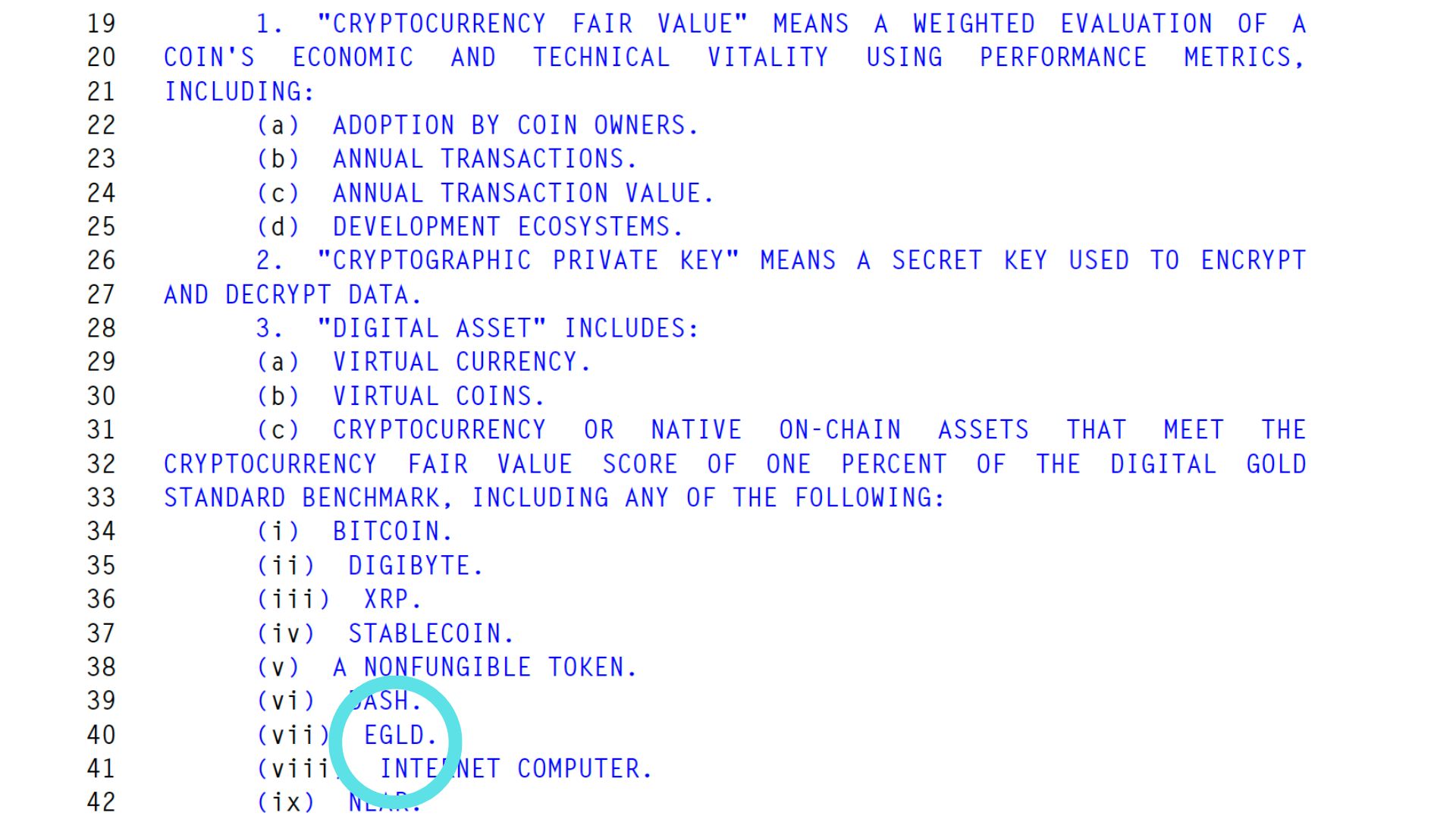
Explicit inclusion by name in US state legislation, under a framework evaluating adoption, transaction activity, and development ecosystems, is a different kind of recognition than exchange listings or community metrics. It reflects the kind of technical track record — consistent protocol delivery, compounding onchain activity, active developer ecosystem — that takes years to build. Arizona's legislators applied a fundamentals screen to digital assets. EGLD passed it.
One Bill in a Larger Shift
Arizona is part of a broader policy movement, and it is accelerating. New Hampshire and Texas have enacted state-level reserve laws. The Trump administration established a federal Strategic Bitcoin Reserve in March 2025. The GENIUS Act, signed into law in July 2025, created the first federal regulatory framework for stablecoins. The CLARITY Act, which passed the House the same month with bipartisan support, is working through the Senate to establish jurisdiction over digital asset markets more broadly. At every level of US government, the question of which digital assets belong in formal institutional frameworks is being actively answered.
SB1649 adds something specific to that answer. Where the GENIUS Act focused on stablecoins and the CLARITY Act addresses market structure and regulatory jurisdiction, SB1649 evaluates which digital assets are suitable for a government to hold. Its merit-based framework — adoption, transaction activity, development ecosystem — asks which assets have earned institutional trust, not just which ones are large enough to regulate.
EGLD is one of twelve assets explicitly named in that framework. The bill has passed the Arizona House and awaits executive review. Taken alongside the federal legislation moving in parallel, it is part of a systematic effort by US policymakers to bring digital assets into formal institutional structures — on terms that reward fundamentals.
The bill is expected to pass the full vote in the coming weeks.