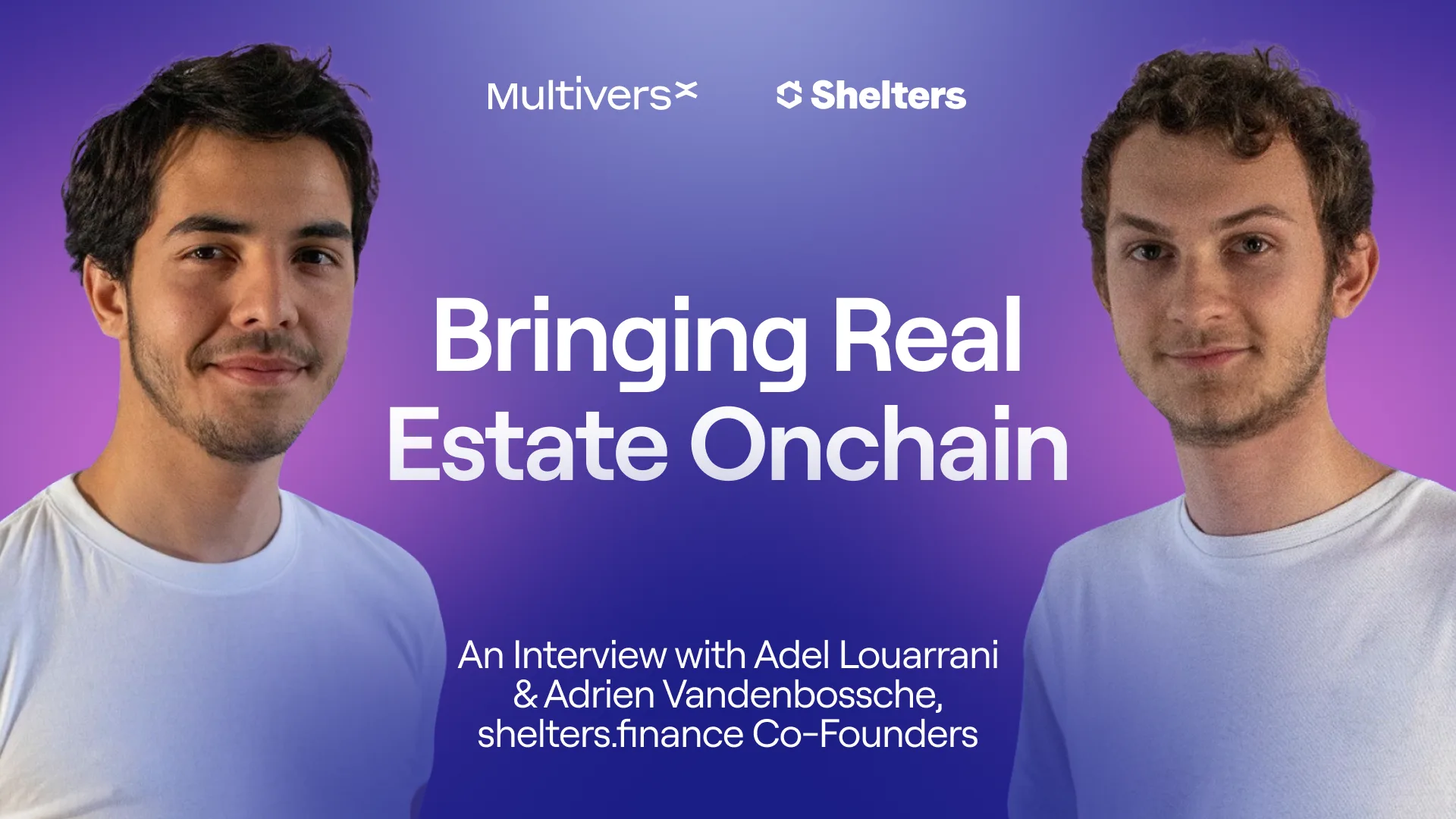
Bringing Real Estate Onchain: An Interview with Adel Louarrani & Adrien Vandenbossche, Shelters.finance Co-Founders
From Parking Lots to Platforms: The Quiet Rise of Tokenized Real Estate
In France, property ownership has long been synonymous with stability. It is also, increasingly, synonymous with exclusion. Rising prices, tightening credit, and layers of administration have turned what was once a rite of passage into a distant ambition for much of a generation.
It was this quiet frustration that led Adrien Vandenbossche and Adel Louarrani to found Shelters, a startup that aims to make real estate accessible through tokenisation — not as a speculative experiment, but as a practical financial product.
The idea did not begin in a boardroom. Several years ago, the two engineers were sitting with friends, drinks on the table, wondering whether it might be possible to buy an apartment together. The answer, after a brief encounter with legal and financial reality, was no.
“Everything about it was too heavy,” Vandenbossche recalls. “The structure, the paperwork, the capital required. It simply wasn’t designed for ordinary people.”
Rather than abandon the idea, they reframed it. What if ownership could be divided cleanly and legally into small parts? What if the entry point were not tens of thousands of euros, but ten?
A deliberately modest first step
Shelters’ first live asset was not a Parisian apartment or a luxury villa, but a parking lot. Seventy-five investors bought fractional stakes. Rent was distributed monthly. It was, by design, unglamorous.
“We wanted something simple and understandable,” says Louarrani. “If it works there, it works anywhere.”
That modest first operation set the tone for the company. Shelters focuses on rental properties, not speculative flips. Returns are designed to be steady rather than spectacular. The promise is not disruption, but reliability.
This approach distinguishes Shelters from many earlier attempts at tokenized real-world assets, which often collapsed under the weight of complexity or over-ambition. Wine that could never be redeemed, properties that existed only on paper — the founders studied these failures closely.
“The technology wasn’t the problem,” Vandenbossche says. “The product was.”
Blockchain without the spectacle
Shelters runs on MultiversX, chosen less for ideology than for usability. Wallets can be created with biometric authentication. Transaction costs are negligible. For the founders, this matters because their target audience is not crypto-native.
“My father can use it,” Vandenbossche says. “That’s the benchmark.”
The blockchain itself is almost invisible to the user — a design choice rather than a technical limitation. For Louarrani, this is essential.
“Blockchain should secure trust,” he says. “It shouldn’t demand attention.”
Trust as the product
“We don’t sell real estate,” Louarrani says. “We sell trust.”
It is an unusually sober framing for a startup operating at the intersection of crypto and property — two sectors not known for restraint.
The founders speak less about growth curves than about repeatability. Their next project, a partnership with a Lyon-based real-estate group, follows the “club deal” structure, capping the investment opportunity at 150 investors.
What matters, they say, is proving that the model can be executed again and again.
“If we can do this fifty times,” Vandenbossche says, “people stop asking whether it works.”
Beyond the crypto cycle
Shelters’ evolution mirrors a broader shift within the blockchain sector. Early assumptions that crypto-native communities would drive adoption have faded, replaced by a focus on mainstream users.
“At first, we thought Web3 would be enough,” Vandenbossche admits. “It isn’t.”
Instead, Shelters now positions itself as an on-ramp — not just to property investment, but to digital finance more broadly. For many users, it will be their first interaction with blockchain technology, though the founders prefer not to emphasise the point.
“The innovation isn’t the blockchain,” Louarrani says. “It’s making ownership ordinary again.”
A quiet ambition
There is little theatricality in how Vandenbossche and Louarrani speak about the future. Their ambition is not to replace banks or reinvent finance, but to build a system that functions quietly in the background.
In an ecosystem accustomed to grand narratives, Shelters’ restraint is striking. It offers no promises of instant wealth, only fractional ownership of tangible assets and the slow accrual of steady returns.
That may be precisely its strength.
As real-world assets continue to migrate, cautiously, onto digital rails, the question is no longer whether the technology works. It is whether anyone can make it boring enough to last.
Shelters is betting that they can. Go to shelters.finance to find out more